
POSTED ON: Mar 23, 2026

In healthcare, reputation crises are no longer sparked by a media headline. Rather, a reputation crisis is often a slow-building concern sparked by a disconnect between patient expectations and the digital experience provided by a healthcare practice. A lag in responding to online patient reviews, inconsistent practice information, and recurring patient complaints related to practice operations are just a few examples.
In This Article
In healthcare, reputation is now directly tied to patient acquisition and patient retention. Our recent survey revealed that 73% of patients use online reviews when choosing a healthcare provider. This is a significant shift in the way healthcare practices must think about patient acquisition and patient retention.
Trust is another interesting dynamic in healthcare. While trust in healthcare systems has historically fluctuated, physicians continue to be highly trusted by patients. A recent survey by the Kaiser Family Foundation revealed that 85% of patients trust their doctor to make the right healthcare recommendation. This is a powerful dynamic, and the first digital experience a patient has with a healthcare practice, a website, and online review sites is essentially the digital front door for patient trust.
In practical terms, reputation is no longer simply a marketing concern. It functions as an operational asset that influences how patients evaluate reliability, responsiveness, and quality of care before the first appointment ever takes place.
Reputation crises in healthcare today are seldom caused by a single event. Instead, small operational gaps accumulate over time until they are highlighted through digital feedback systems.
One problem is that of the feedback vacuum. Patients who post negative feedback that is not responded to may assume that a healthcare practice is indifferent to patient needs. Even a handful of unresolved patient feedback can give the appearance that a healthcare practice is disengaged from patient needs.
Another source of reputation risk comes from friction in basic access information. Inconsistent or outdated name, address, or phone information across directories can lead to missed calls, incorrect directions, and frustrated patients who struggle to reach the practice.
The third challenge relates to what can be referred to as the sentiment blind spot. Issues like operational problems, long waiting times, billing issues, and communication problems can appear in customer reviews, but unless these are monitored, they can go unnoticed until customer ratings begin to drop.
Interestingly, the presence of negative reviews alone is not necessarily harmful. According to the RepuGen 2025 Patient Review Survey, 55.56% of patients say negative reviews do not influence their decision when a practice maintains mostly positive ratings. More notably, 25.63% of patients report that seeing negative reviews handled professionally has a positive impact on their decision, compared with 18.81% who say it discourages them.
This highlights an important principle in reputation management. Trust is not built by avoiding criticism entirely but by demonstrating thoughtful responses and visible accountability.
Reputation strength is therefore defined less by the absence of complaints and more by how transparently and effectively they are addressed.
The most effective form of crisis management happens before an issue becomes public. Practices that proactively gather patient feedback gain an opportunity to address concerns before they even escalate into online reviews.
A common approach involves a two-track feedback system supported by automated surveys.
The first track captures feedback internally by sending patients a brief survey through SMS or email shortly after their visit. This timing allows patients to share impressions while the experience is still fresh.
The second track identifies patients who express dissatisfaction through lower survey scores. Instead of directing them immediately to public review platforms, these responses are routed into a service recovery workflow where practice staff can review concerns and respond directly.
This approach allows practices to identify issues early and resolve them before patients feel the need to post negative feedback publicly. Importantly, the system still provides every patient with the opportunity to leave an online review if they choose, ensuring the process remains transparent and compliant with review guidelines.
Multi-question surveys also provide valuable context behind patient dissatisfaction. Rather than simply recording a low rating, they help reveal whether the issue involved communication gaps, scheduling delays, billing concerns, or other operational factors.
This insight transforms feedback into actionable information rather than isolated complaints.
When negative reviews do appear publicly, response speed becomes an important factor in shaping perception.
Research indicates that 59.48% of patients are more likely to choose a healthcare provider who responds to both positive and negative reviews. Engagement signals attentiveness and accountability, two qualities that strongly influence patient trust.
Consumer expectations around response time are also increasing. BrightLocal research shows that 19% of consumers expect a response the same day they post a review, 32% expect a response within the following day, and 81% expect to hear back within a week.
Meeting these expectations can be challenging for busy healthcare teams, particularly when responses must remain professional and compliant with privacy regulations.
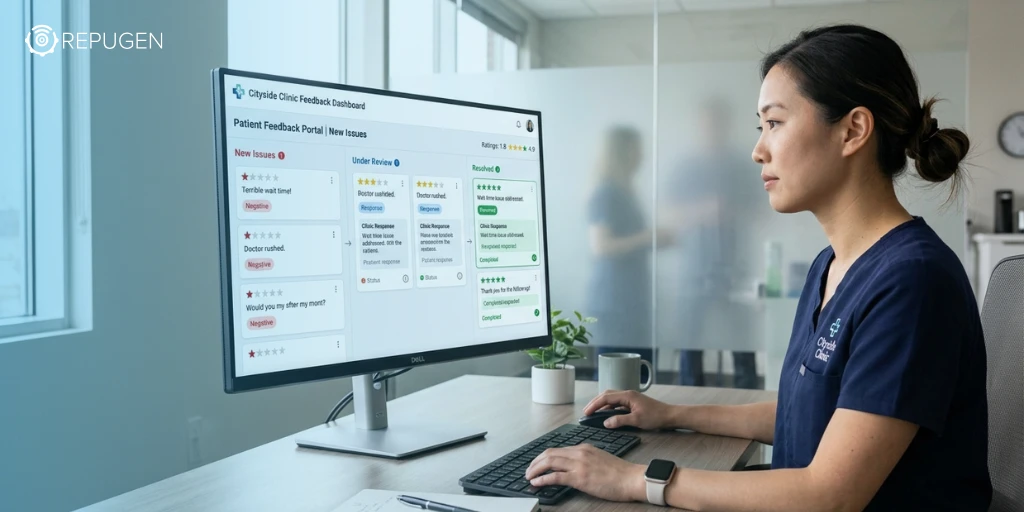
Centralized review management platforms help address this challenge by consolidating reviews from multiple healthcare platforms into a single dashboard. This allows practice staff to monitor feedback, respond quickly, and maintain consistent messaging across sites such as Google, Healthgrades, and WebMD.
AI-assisted response tools can further support this process by generating empathetic and compliant responses that help practices acknowledge feedback without risking privacy violations.
Reputation crises may start as minor operational trends. Recognizing these trends early on helps healthcare organizations address the problem before it becomes a crisis.
Sentiment analysis tools use artificial intelligence technology to analyze a large amount of patient feedback and reviews from surveys. These tools help healthcare organizations recognize common themes in patient feedback.
The tool acts as an early alert system. If a negative sentiment starts building up around a particular problem, the organization can investigate the operational cause of the problem and address it accordingly.
Survey data reinforces the importance of sentiment in patient decision-making. The RepuGen Patient Review Survey found that 46.49% of patients consider the specific sentiment expressed in reviews to be the most important factor when choosing a healthcare provider.
High-performing healthcare organizations increasingly treat digital feedback as operational intelligence rather than simply a marketing metric. Monitoring patient sentiment with the same discipline applied to clinical quality allows organizations to respond proactively to emerging risks.
Reviews may get the bulk of the attention in the reputation management debate, yet accurate provider information may be one of the most fundamental trust factors in healthcare.
Name, address, and phone number inaccuracies in various directories can cause friction with patients. If a person seeking care encounters incorrect contact information or conflicting address information, the situation can quickly erode trust.
Survey data shows that 67.58% of patients cross-verify a provider’s address and phone number across multiple websites before scheduling an appointment. Inconsistent listings, therefore, create both operational frustration and reputational risk.
Healthcare directories also play a prominent role in search visibility. Studies show that directory listings appear in 34% of high-intent medical searches, meaning patients frequently encounter these platforms during the decision-making process.
Centralized listing management systems can assist in managing information on dozens of healthcare directories. This can ensure that information, including location and service information, is consistent everywhere patients search. This can increase reliability and visibility.
Practices that wish to manage listing information more efficiently can look into options like RepuGen, a listing management platform that can manage information on major directories and review sites.
Healthcare reputation management has grown far beyond traditional public relations. In a digital-first world of healthcare, reputation is now defined by a healthcare practice's ability to manage patient feedback, operational transparency, and digital accuracy.
Negative feedback can be a strength if leveraged well. Operational trends can be a powerful tool for making positive changes to patient experiences. Digital accuracy is a key differentiator that helps patients find us more easily.
Taken together, these capabilities form the foundation of a modern reputation strategy built on data, responsiveness, and transparency.
Platforms such as RepuGen enable healthcare organizations to bring these elements together by transforming patient feedback into actionable insights and integrating digital reputation management into everyday operations.
In an era where patients increasingly evaluate providers through digital channels, building this kind of trust infrastructure is no longer optional. It has become a defining advantage for healthcare organizations seeking to deliver both excellent care and consistent patient confidence.

Banner Image Source: Google Flow
Recent Posts
0 Comment
Your email address will not be published. Required fields are marked *