
POSTED ON: Feb 18, 2026


When patients look for a healthcare provider today, they don’t just read reviews and glance at star ratings. They verify details. They cross-check addresses, confirm phone numbers, and compare listings across platforms before deciding whether a practice feels reliable enough to contact.
In This Article
This behavior isn’t speculative; it’s measurable. According to RepuGen’s 2025 consumer survey, 67.58% of respondents said they check whether a healthcare provider’s address and phone number match the information on the provider’s website when reading reviews. That moment of verification plays a quiet but critical role in patient decision-making in healthcare.
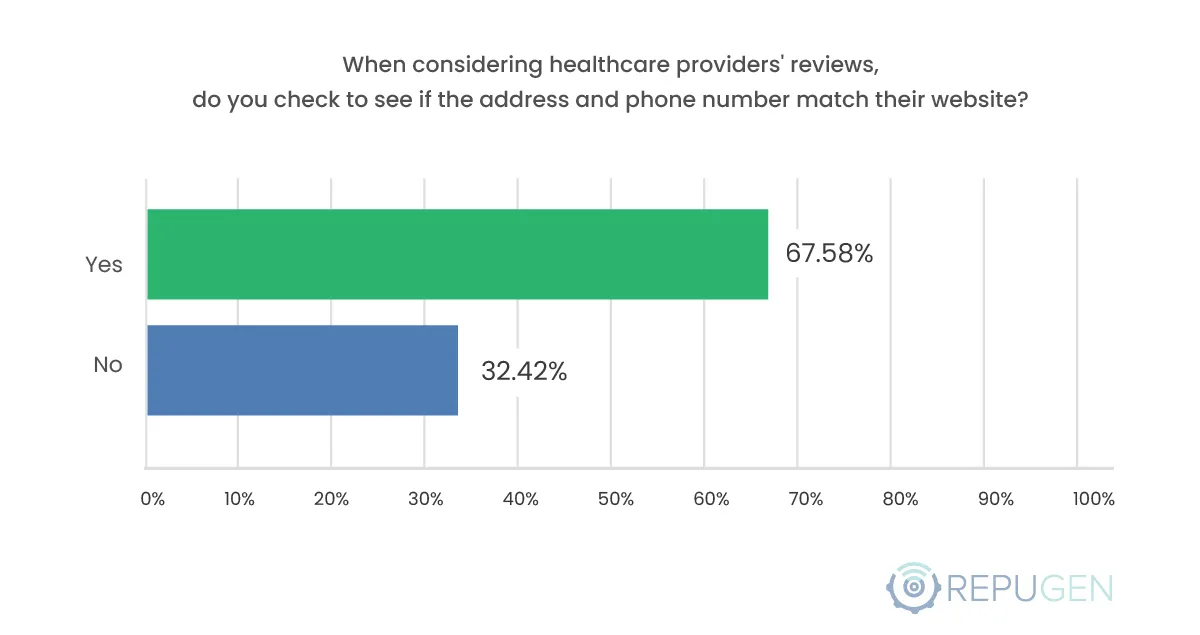
What patients find during that check often determines whether they move forward or move on. When information aligns, it reinforces trust. When it doesn’t, doubt creeps in. For leading practices, accurate NAP information isn’t just about rankings; it also helps prevent missed calls, improve appointment follow-through, and reinforce credibility across digital touchpoints, directly supporting patient retention and revenue growth. This isn’t simply a technical or SEO issue; it’s a credibility signal that practices pay close attention to so potential patients don’t fall through the cracks.
NAP consistency refers to the accuracy and uniformity of a healthcare provider’s core identifying information across the internet:
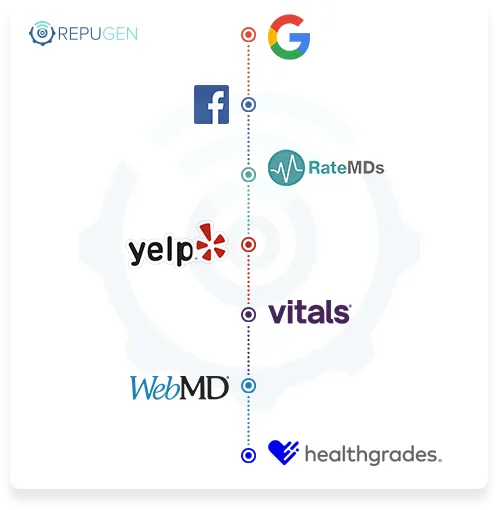
This information appears in far more places than many practices realize. It lives across Google Business Profiles, review platforms, healthcare directory listings, map services, social profiles, and practice websites. Patients encounter these touchpoints at different moments in their search journey, often without realizing how many systems they’re interacting with.
From a patient’s perspective, consistency is expected. When the same practice appears with slightly different details across platforms, it raises questions. From a platform perspective, NAP consistency functions as a digital trust signal. It helps search engines, maps, and increasingly AI-driven systems confirm that a business is legitimate, active, and accurately represented.
In healthcare, especially, where trust is foundational, NAP consistency quietly supports both patient confidence and platform interpretation.
Verification has become routine for how patients evaluate providers. Rarely does a patient rely on a single platform. Instead, they move between review sites, healthcare provider directories, maps, and practice websites to build confidence before making contact.
This behavior becomes even more pronounced during comparison-based searches. Business directories play a significant role at this stage. Directories surface in 34% of “best dentist” searches and 23% of “best vet clinic” searches, placing them squarely in the decision-making phase rather than discovery alone.
At this point, patients are doing two things simultaneously: comparing reputation and verifying accuracy. They’re asking quiet questions like, “Is this practice real?” and “Do these details line up?” Consistent NAP information across healthcare directory listings and websites reassures patients that the practice is attentive, reliable, and worth contacting.
NAP inconsistency doesn’t usually trigger overt complaints. Its impact is subtle, and that’s what makes it costly.
When phone numbers don’t match or when addresses appear differently across platforms, patients encounter friction. Rather than investigating further, many simply choose another provider whose information feels more precise and more dependable. The loss happens silently, without feedback or explanation.
Patients often interpret mismatched information as a sign of deeper issues. It can suggest outdated operations, a lack of attention to detail, or unreliable practice management. These impressions form quickly and quietly, long before any interaction with staff or clinicians occurs.
The practical consequences are just as real. Patients may call an outdated phone number and reach a dead line. Others may arrive at an old address, already frustrated before their appointment begins. These are not edge cases; they’re everyday experiences when listings aren’t actively managed.
Behind the scenes, search engines and AI systems rely on consistent entity data to understand and validate businesses. When a practice’s information aligns across primary citation sources, it becomes easier for platforms to confirm legitimacy and reduce confusion.
In fact, businesses with consistent NAP data across primary citation sources are 40% more likely to appear in the local pack. Through conversations with ChatGPT, we learned that AI-powered search experiences often rely on consistent NAP information as a supporting signal when determining which healthcare practices to surface.
Rather than focusing on algorithms, the pattern is clear: practices with consistent information appear more reliable across local search results, map listings, and AI-generated summaries, strengthening overall healthcare reputation management efforts. Consistent NAP helps platforms confirm business legitimacy, reduce entity confusion, and deliver accurate local results, benefiting both visibility and patient trust.
NAP inconsistency is rarely intentional. More often, it’s a byproduct of operational complexity, especially for growing practices.
Common causes include practice relocations or suite changes that aren’t updated everywhere, phone number changes for scheduling or call tracking, and multiple providers or locations operating under a single brand. Unclaimed or forgotten directory listings also play a role, as do minor formatting differences, such as suite numbers, abbreviations, and punctuation, that create mismatches across platforms.
The key point is this: NAP inconsistency isn’t a sign of poor management. It’s a scalability challenge many healthcare organizations face as their digital presence grows faster than manual updates can keep pace. Practices that take the time to correct even minor NAP inconsistencies signal accuracy and reliability to search engines and AI systems, positioning themselves a step ahead of competitors who overlook these details and leave trust on the table.
Addressing NAP inconsistency requires more than one-off fixes. It requires a system designed for accuracy and oversight.
RepuGen partners with Yext to provide centralized listing management for healthcare practices, enabling practice information to be managed from a single, authoritative source. This approach reduces the effort and risk involved in updating multiple platforms individually and helps ensure changes are reflected consistently across the broader digital ecosystem.
Rather than relying on periodic audits, RepuGen continuously monitors listings to identify mismatches in name, address, and phone number. This proactive approach helps practices catch inconsistencies early, before they affect patient trust or visibility.
Consistency supports patients at every step, helping them find accurate directions, reach the correct phone number, and confirm they’re choosing a credible provider. It also reinforces reputation signals across platforms without making promises about rankings or revenue. The focus remains where it belongs: accuracy, reliability, and trust.
As patients compare healthcare providers, accurate and consistent information plays a quiet but influential role in shaping confidence. When practice details align across platforms, it creates a smoother, more reassuring experience at the exact moment patients are deciding who to contact.
Leading practices recognize that accuracy goes beyond technical correctness. Consistent information across healthcare directories and search experiences signals professionalism, reliability, and operational strength, qualities patients naturally associate with high-performing providers. In an environment increasingly shaped by AI-driven discovery and patient-led research, this consistency helps practices stand out and compete more effectively with top providers in their market.
RepuGen supports this effort by helping practices maintain accurate information, reduce inconsistencies, and present a dependable, unified presence wherever patients are searching, creating stronger foundations for growth, visibility, and long-term trust.

Banner Image Source: Google Whisk AI
Recent Posts
0 Comment
Your email address will not be published. Required fields are marked *