

POSTED ON: Apr 27, 2026

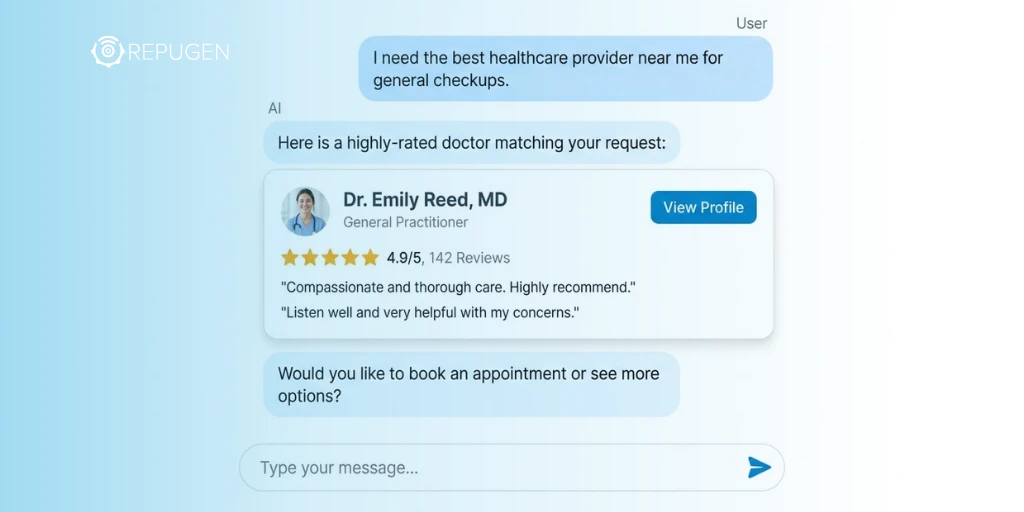
For two decades, getting found online meant playing by Google's rules: keywords, backlinks, click-through rates, and a list of ten blue links. Practices that mastered those rules stayed visible. Practices that ignored them quietly disappeared.
Those rules are being rewritten.
When a patient today asks their voice assistant, "Who is the best cardiologist near me?" or opens Google and sees an AI Overview before any search results, they are not receiving a list of links to evaluate. They are receiving a single, synthesized answer, one recommendation, assembled in seconds, backed by signals most practices have never thought to manage.
The scale of this shift is hard to overstate. Half of consumers polled in an August 2025 McKinsey survey actively seek out AI-powered search engines. By 2028, AI-powered search is projected to influence $750 billion in consumer spending. A separate McKinsey analysis found that 44% of users already prefer AI search over traditional results for everyday queries. And according to RepuGen's own research, 40% of patients now use AI tools to research healthcare providers before booking an appointment.
The Wall Street Journal captured the urgency bluntly: the old rules of Google search are being rewritten by AI, and every business that built its visibility on those old rules is being forced to adapt or accept invisibility.
For healthcare providers, the stakes are higher than for most. A patient choosing a restaurant based on an AI recommendation makes a low-stakes decision. A patient choosing a physician, specialist, or urgent care clinic based on that same recommendation is making a decision about their health. AI systems that power these recommendations know this too, and they evaluate healthcare providers through a distinctly different, far more rigorous lens.
The question every practice should be asking right now is simple: when a patient asks AI to recommend a provider like you, what does it actually see?
AI search engines do not browse your website the way a patient does. They do not read your homepage headline, admire your team photo, or feel reassured by your "20 years of experience" tagline. Instead, they systematically evaluate a set of structured authority signals to determine whether your practice is credible enough to recommend.
Understanding these signals is not optional. It is the foundation of AI visibility for healthcare providers in 2026 and beyond. We call this the Authority Signals Framework (ASF), the 4 pillars AI uses to verify your practice before surfacing it in a recommendation.
AI tools are trained to prioritize medically credible sources, and that same logic extends to healthcare provider profiles. When evaluating a physician or specialist, AI systems scan for markers of clinical legitimacy: credentials such as MD, DO, or PhD; board certifications in recognizable specialties; published work or institutional affiliations; and author bios that clearly identify who is behind the content.
A thin or absent physician profile is not neutral. It is a liability. If AI cannot verify that your providers are credentialed professionals, it will simply opt for a practice that makes that information easy to find.
Implication: Every physician at your practice needs a complete, credential-rich profile on your website and across major directories. Credentials should be listed explicitly, not buried in jargon or assumed from a specialty label.
At an individual level, this is where reputation management for doctors begins, ensuring that each provider’s credentials, expertise, and professional identity are clearly visible and verifiable across platforms.
AI systems are designed to evaluate the company that a provider keeps. Practices affiliated with recognized medical institutions, hospital networks, and government-backed directories carry a form of inherited authority, a trust loop that AI uses as a credibility shortcut.
For independent or single-location practices, this creates a real challenge. You may not have a hospital network behind you. What you can control is where your practice appears and how consistently your information is presented across high-authority directories: the NPI Registry, Google Business Profile, Healthgrades, WebMD, Zocdoc, and others. Consistency is not just tidiness, it is a trust signal.
Implication: Small practices must ensure that their name, address, and phone number (NAP data) are identical across all relevant directories. A single discrepancy can fracture the trust loop AI relies on to verify your identity.
One of the more nuanced signals AI uses to evaluate health content is whether it has been reviewed by a qualified clinician. Medical review statements, the "Reviewed by Dr. [Name], MD" disclosures that appear on health platforms, function as a compensatory credibility signal. Research shows that these statements appear in 71.1% of sources cited by AI health tools, suggesting that AI systems have learned to treat them as a proxy for accuracy and trustworthiness.
For practices without the institutional weight of a major hospital network, this is one of the most accessible ways to close the credibility gap. Adding a clear medical review statement to your website content, blog posts, and provider bios signals to AI that your information meets a professional standard.
This is where the conversation becomes most consequential for your practice and for RepuGen's role in your strategy.
AI does not rely solely on what you say about yourself. It evaluates what your patients say about you. Reviews, ratings, and patient narratives across platforms provide critical external context that AI systems use to verify whether a practice is genuinely trusted in the real world.
AI tools use Natural Language Processing (NLP) techniques, including Named Entity Recognition (NER), to extract themes from review text and identify recurring qualities such as "wait time," "staff behavior," and "treatment clarity," building a thematic profile of your practice.
Implication: A practice with 200 thin, one-line reviews may be outperformed by a practice with 80 detailed, experience-rich reviews, because the latter gives AI more to work with. Practices must actively generate, monitor, and respond to patient feedback to strengthen this pillar.
This is where a structured healthcare reputation management strategy becomes essential, because AI is evaluating not just volume, but the quality, consistency, and meaning behind patient feedback.
| Signal | What AI Looks For | Risk If Missing |
|---|---|---|
| Physician credentials | MD/DO/PhD tags, board certifications, complete bios | AI skips the provider as unverifiable |
| NAP consistency | Identical name, address, phone number across all directories | AI loses confidence in the listing |
| Medical review statements | "Reviewed by [Name, Credential]" on content pages | Lower credibility score vs. reviewed sources |
| Review recency | Fresh reviews are generated consistently | AI surfaces more recently updated competitors |
| Review narrative depth | Detailed patient feedback with specific themes | AI favors richer sentiment data |
| Structured data (Schema) | Labeled provider info, location, services, FAQs | AI cannot accurately categorize your practice |
| Response activity | Practice replies to reviews, including negative ones | Lower engagement signal, reduced trust |
For years, the star rating was the currency of online reputation. A 4.8 was better than a 4.3. Higher was better. End of story.
AI has changed that story entirely.
According to RepuGen's patient review survey, 46.49% of patients say that the sentiment conveyed in review text is the primary factor influencing their trust in a provider, compared to just 16.97% who cite the star rating itself. In other words, what patients write matters nearly three times more than what number they assign.
AI has arrived at the same conclusion and for similar reasons.
Think about the difference between the two reviews. The first reads: "Great doctor. Five stars." The second reads: "Dr. Chen explained my diagnosis in plain language, never made me feel rushed, and her front desk team was genuinely warm. I left feeling heard for the first time in years."
Both might carry the same star rating. But only one of them tells AI anything useful.
This is the concept of Narrative Density, the richness of detail within a patient's review. Practices with more detailed patient feedback consistently perform better in AI-driven searches because detailed reviews provide AI with more semantic material to work with. They allow AI to confirm that a practice is genuinely skilled in the areas patients care about most, rather than simply popular in a vague, unverifiable way.
It is worth noting that practices cannot control how much detail a patient chooses to include in their feedback. What can be controlled is the environment that shapes that feedback, consistently capturing patient sentiment, acting on what they hear, and improving the overall care experience so that patients feel compelled to say something meaningful.
As established above, AI uses Named Entity Recognition to extract and catalog thematic qualities from review text, building a semantic profile of your practice from potentially thousands of data points. RepuGen's CommentWiz surfaces these recurring themes in real time, giving your team structured intelligence to act on rather than an overwhelming stack of individual reviews to read manually.
Here is something most practice managers and marketing directors do not know: AI tools do not read your website the way a patient does.
A patient visits your homepage and makes a judgment call based on first impressions, the design, the tone, and whether your team looks approachable. AI visits your website looking for something entirely different. It is looking for clearly organized, consistently labeled information. If it cannot find that, it will move on to a competitor's site that makes it easier.
Think of your website like a packaged food product on a supermarket shelf. A person can pick it up, read the front of the box, and understand roughly what it is just by looking. But for a machine, whether it is a grocery inventory system or an AI search engine, that is not enough. It needs the nutrition label. It needs structured information in a consistent format that it can reliably interpret.
In the world of websites, that nutrition label is called Schema, or structured data. It is a way of labeling your website so that AI tools can instantly understand who you are, what services you offer, where you are located, and what patients say about you.
The three most important things to have clearly labeled on your website are:
Your physician and provider profiles. Each profile should clearly state the provider's name, specialty, credentials, languages spoken, and location. This is what AI uses to verify that a real, qualified clinician works at your practice.
Your clinic's location and specialty information. Your address, phone number, hours of operation, and services offered should be marked up consistently and matched exactly to what appears on your Google Business Profile and other directories.
A plain-language FAQ section. This is more important than most practices realize, and we will return to it shortly. A FAQ page written in the language patients actually use, not medical jargon, is one of the most effective ways to signal to AI that your website answers real patient questions.
If your website currently has no structured labeling, AI is essentially guessing what your practice does and who you serve. And when it is uncertain, it will recommend someone it is not uncertain about.
Beyond your website, AI tools are constantly cross-referencing your information across multiple platforms to form a single, consolidated understanding of your practice. Your Google Business Profile, your hospital directory listing, your Healthgrades page, and your own website are all data points that AI attempts to stitch together into one coherent "entity."
When those data points contradict each other, a different phone number here, a slightly different practice name there, an address listed without a suite number on one platform and with it on another, AI interprets those inconsistencies as a sign of uncertainty. It cannot be confident that it is recommending the right place. The result is what we call Silent Exclusion: your practice is not penalized or flagged. It is simply overlooked, invisibly passed over in favor of a practice whose information is clean and consistent.
The fix is not complicated. It requires a systematic audit of your listing data across all major platforms, followed by a process to keep that data synchronized. RepuGen's Listings Management automates this by pushing standardized practice data to 60+ relevant directories from a single dashboard, eliminating inconsistencies that can cause AI to doubt you.
There is an important tension at the heart of AI-driven healthcare search, and every practice needs to understand it. Patients are using AI as a starting point for their provider search, but they are not yet fully trusting it. According to a Deloitte report, 74% of consumers still view their own doctors as their most trusted source of health information, and 80% say they want transparency about how AI is being used in the healthcare information they consume. The practices that convert AI-driven discovery into actual appointments are those that make the human element visible and patient reviews are the most powerful way to do that.
Patients are willing to use AI as a starting point for their provider search. What they are looking for at the end of that search is evidence that a real practice with real human care lies behind the AI-generated recommendation. The practices that convert AI-driven discovery into actual appointments are those that make the human element visible, and patient reviews are the most powerful way to do that.
Fifty-nine percent of patients say they trust a provider more when they see the practice actively engaging with patient feedback. This is not just a patient preference, it is a behavior that AI detects as a credibility signal. A practice that consistently responds to reviews is demonstrating accountability, engagement, and a level of professional care that extends beyond the appointment itself.
One of the most counterintuitive findings from RepuGen's patient review survey is what it reveals about negative reviews. More patients say negative reviews positively influence their decision to choose a provider (25.63%) than those who say they have a negative influence (18.81%). Why? Because a thoughtfully handled negative review shows that the practice listens, takes feedback seriously, and is committed to doing better. It is a trust signal in disguise.
RepuGen's ReplyWize and CommentWiz tools are built specifically for this moment. ReplyWize generates HIPAA-compliant response drafts quickly, so no review goes unanswered. CommentWiz analyzes the sentiment landscape of your feedback so your team can understand which themes are surfacing across your patient base. Both tools keep human oversight at the center; every response is reviewed by a real person before it is posted, ensuring that the professionalism and empathy of your practice always come through.
Why it matters: AI cross-references your details across multiple directories to verify your identity. Inconsistencies cause AI to lose confidence in your listing and either skip you entirely or quietly ignore you, rather than penalize you.
Solution: Audit your top directory listings, or use RepuGen's Listings Management to automatically standardize and push your data across 60+ relevant platforms from one dashboard.
Why it matters: 62% of patients do not trust reviews older than two years. AI systems are generally more likely to surface recently and consistently updated information sources. A strong rating earned three years ago may no longer carry the weight it once did.
Solution: Use RepuGen's fully automated and customizable review cadences to send requests after every patient visit, so new feedback flows in continuously rather than in sporadic bursts.
Why it matters: AI users search conversationally and with specific context. "Which urgent care near me takes Aetna?" is a very different query from "urgent care Aetna." If your website does not mirror those real-world questions in plain language, AI will not pull it as a trusted source.
Solution: Add a plain-language FAQ page covering your specialties, accepted insurance, location, and how to book, written the way a patient would actually ask, not the way a clinician would answer.
Why it matters: Incomplete provider profiles, missing specialties, credentials, or languages spoken, are one of the top reasons AI skips a clinic when forming a recommendation. If AI cannot verify who works there, it recommends someone it can verify.
Solution: Audit every physician profile on your website and across platforms like Healthgrades and WebMD. RepuGen's Listings Management tool allows you to manage and sync this data centrally so nothing falls through the cracks.
Why it matters: Patients consistently trust providers more when they see a practice actively engaging with feedback, including on negative reviews. As covered above, a thoughtfully handled critical review signals accountability and professional care, both of which AI treats as indicators of credibility.
Solution: Use RepuGen's CommentWiz and ReplyWize to monitor sentiment, quickly draft HIPAA-compliant responses, and ensure that a human reviews every reply before it posts.
What signals do AI tools like ChatGPT and Google use to recommend a healthcare provider?
AI tools evaluate a combination of signals when forming healthcare recommendations. These typically include physician credentials and author bios, ratings and review volume, the content and sentiment of patient reviews, consistency of practice information across directories, and how clearly a practice's website communicates its services, location, and specialties. No single signal dominates, AI weighs all of them together to determine overall credibility.
How is AI search different from traditional Google search for patients looking for a doctor?
Traditional Google search returns a ranked list of links that patients must evaluate themselves. AI search synthesizes information from multiple sources and delivers a single, direct answer often a specific recommendation or a short list with supporting reasons. This means the decision-making process has shifted earlier, and the signals AI uses to form its answer are not the same ones that traditional SEO was built to optimize.
Does having more reviews always mean better AI visibility for my practice?
Not necessarily. Volume matters, but it is not the only factor. AI also evaluates the recency of reviews, the detail and narrative richness of the text, and the consistency of themes across your feedback. A practice with fewer but more detailed, experience-rich reviews may outperform one with a higher volume of generic one-liners, because the detailed reviews give AI more meaningful content to work with.
How does patient sentiment in reviews affect how AI ranks my practice?
AI uses Natural Language Processing to extract themes from review text, such as "wait time," "communication," "bedside manner," and "staff friendliness." These thematic signals give AI a nuanced picture of your practice that goes far beyond a star rating. According to RepuGen's patient review survey, 46.49% of patients say review sentiment is the primary driver of their trust, compared to just 16.97% who prioritize the star rating itself. AI has effectively arrived at the same weighting.
What is structured data, and why does it matter for my practice's online visibility?
Structured data (also called Schema) is a way of labeling your website's information so that AI tools can immediately understand who you are, what you do, and where you are located. Think of it as the nutrition label your website needs, so AI doesn't have to guess. Without it, AI may misclassify your practice, skip it entirely, or recommend a competitor whose site is more clearly organized.
How often should my practice be collecting new patient reviews to stay visible in AI search?
Consistently, ideally after every patient visit. Sixty-two percent of patients do not trust reviews older than two years, and AI systems favor information sources that are up to date and actively maintained. The goal is not a periodic campaign but a steady, automated flow of fresh feedback that keeps your practice's reputation current and competitive.
Can a small or single-location practice compete with large hospital networks in AI search results?
Yes, but it requires a deliberate strategy. Large hospital networks have institutional authority built in. Small practices can compete by ensuring perfect NAP consistency across directories, maintaining a strong, up-to-date base of detailed patient reviews, keeping physician profiles complete and credible, and adding structured data to their websites. Where big networks have scale, small practices can win on specificity, recency, and sentiment richness.
The shift to AI-driven healthcare search is not a future concern. It is happening right now in the way your prospective patients find and choose providers today.
Reputation Management, Online Visibility, and Patient Satisfaction are no longer separate strategies. In the age of AI search, they are a single, unified signal, and the practices that treat them that way will be the ones AI recommends.
The good news is that you do not have to manage all of this separately or manually. RepuGen's RepuGenie is the unified platform built specifically for healthcare providers who want to take control of their AI-era reputation. It brings together review collection, sentiment analysis, listing management, and HIPAA-compliant response tools in one place, so the signals AI looks for are always working in your favor.
Don't let your practice become invisible. Start building your AI-ready reputation today.
Get a Demo →

Banner Image Source: Google Flow
Recent Posts
0 Comment
Your email address will not be published. Required fields are marked *