POSTED ON: Nov 23, 2026


Your appointment calendar is full. Patient volume is increasing, revenue is growing, and your providers are seeing more patients than ever. By every business measure, your practice is doing well.
Then you check your Google Business Profile. Your star rating has dropped, and recent patient reviews are becoming increasingly negative.
What changed if the quality of care hasn't?
Two problems often explain this contradiction. First, everyday operations may not have kept pace with growth. Second, your review collection process may still be reaching the same number of patients it did when your practice was smaller.
The good news is that you can investigate both using information your practice already collects.
When patient volume increases, but ratings decline, look for two problems: operational bottlenecks and inconsistent review collection. Start by calculating reviews per 100 patient visits. If that number has fallen, your review collection may not be keeping up with growth. If it remains stable but ratings decline, investigate recurring complaints about scheduling, wait times, staff interactions, and billing. Invite every patient to leave an honest review, not just those who appear satisfied.
Patient reviews often worsen as a practice grows because administrative processes struggle to keep up with rising demand. Longer waits, missed calls, overworked front-desk employees, and billing delays affect the patient experience. Meanwhile, inconsistent review requests can skew public feedback toward patients with particularly strong experiences.
This doesn't necessarily mean your doctors are providing worse care.
According to RepuGen's analysis of more than 3.2 million patient reviews across 10 healthcare specialties, patients rate clinical interactions much more favorably than several operational aspects of their visits.
The study found these average ratings:
Staff: 4.6 out of 5
Doctors: 4.4 out of 5
Front desk: 3.6 out of 5
Wait times: 2.9 out of 5
Billing transparency: 2.8 out of 5
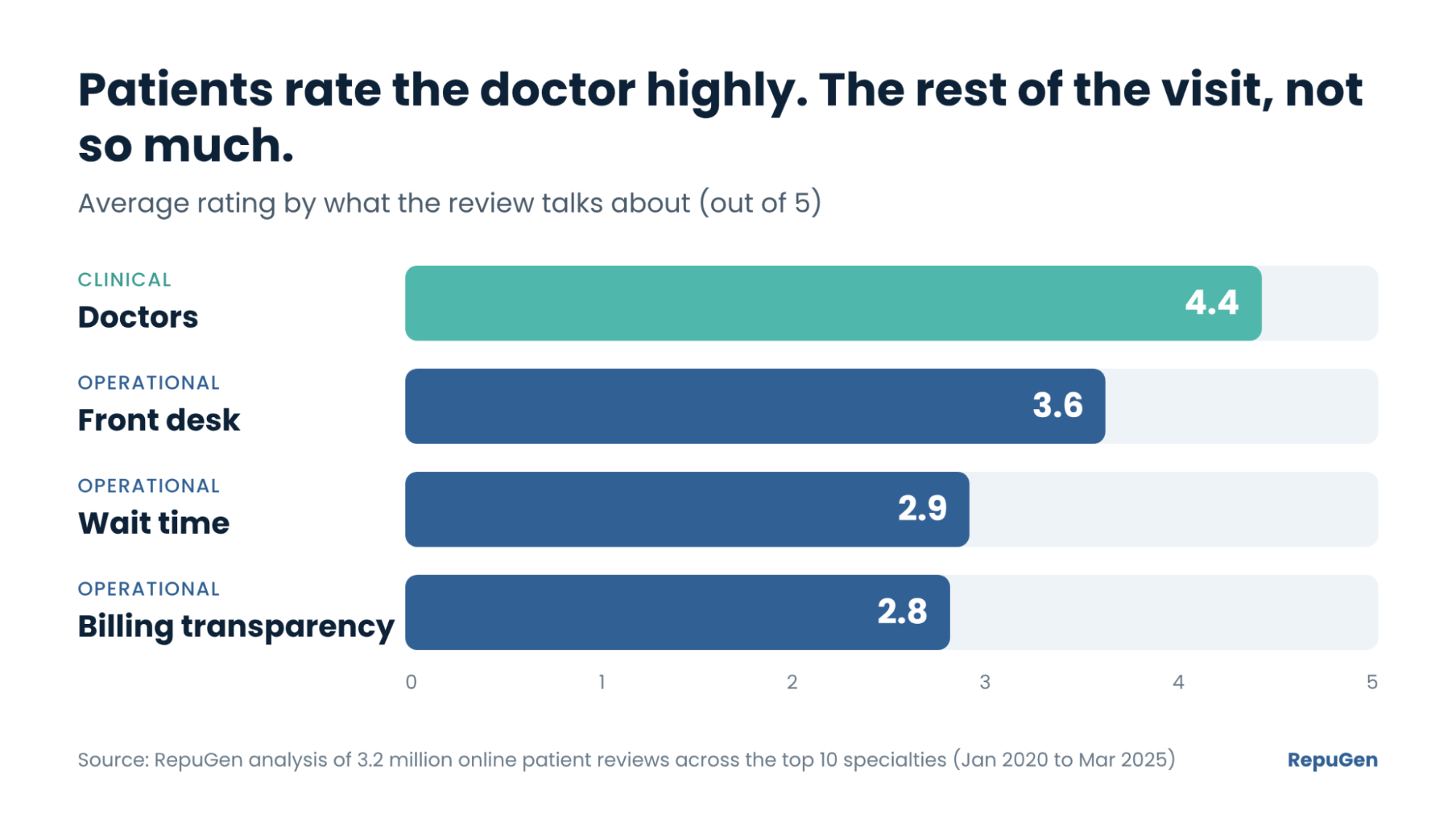
These findings highlight a critical distinction in healthcare patient satisfaction: patients evaluate the entire visit, not just the medical treatment they receive.
As your practice grows, even small administrative problems can affect more patients and become recurring themes in online reviews.
Yes, and this is one of the easiest problems to overlook.
Imagine your practice previously saw 1,000 patients per month and received 30 Google reviews. After expanding, monthly visits increased to 1,300, but you still received only 30 reviews.
Your review count hasn't decreased, but your reviews per 100 visits have fallen from 3 to approximately 2.3.
That difference matters.
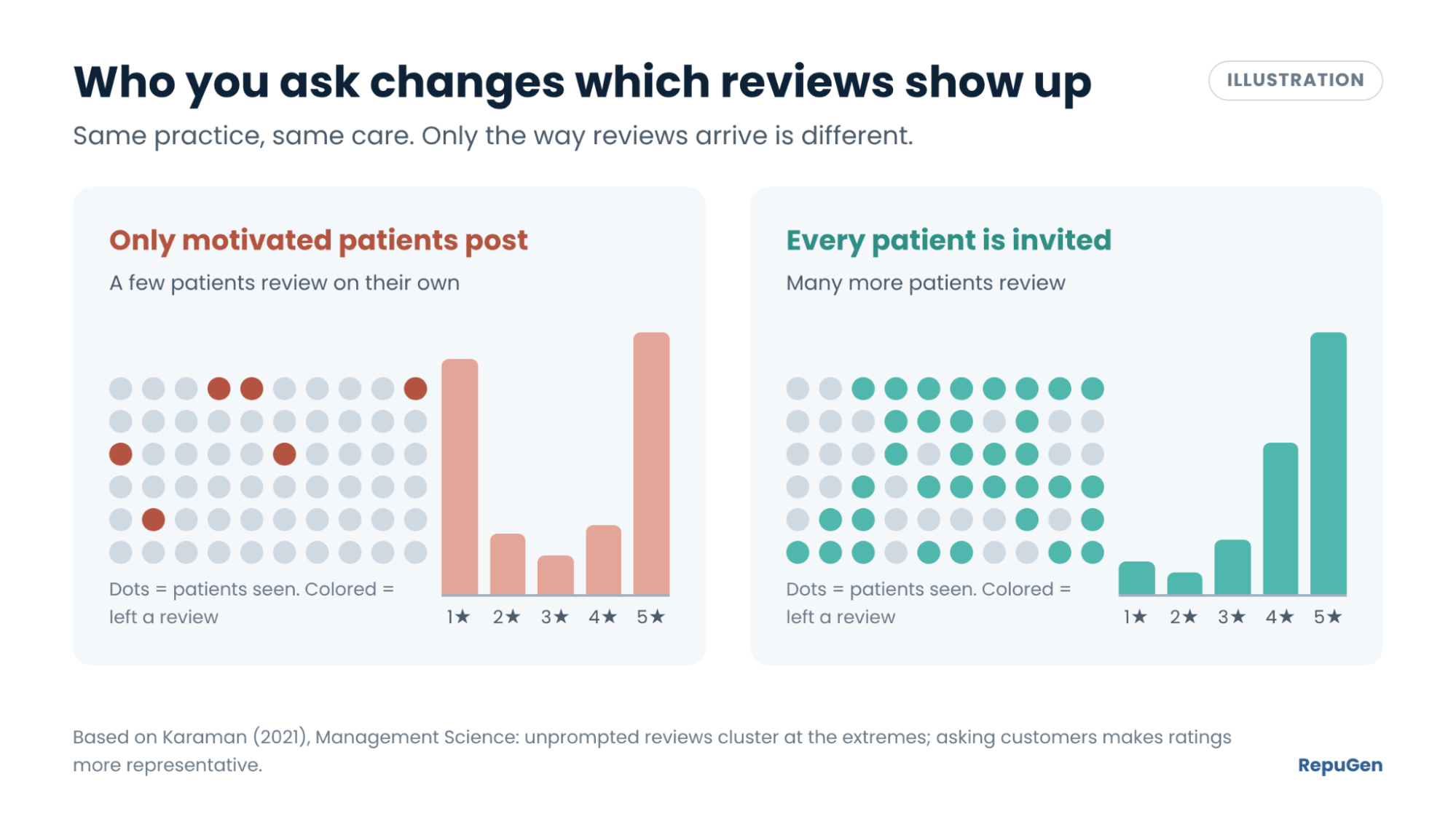
When fewer patients are invited to share feedback relative to total visits, public reviews become increasingly dependent on people who decide to post without being asked.
Those patients may have particularly positive or negative experiences, leaving routine, satisfactory visits underrepresented.
Research supports this possibility.
A 2021 study by Hülya Karaman published in Management Science examined how review requests affect online rating distributions. The study, conducted in hospitality rather than healthcare, found that unsolicited reviews tended toward extreme ratings.
Requesting reviews encouraged more people with moderate experiences to participate, making the distribution more representative. The study also found an association between review solicitation and fewer one-star reviews on a third-party platform.
The lesson for medical practices is straightforward: consistent, unbiased review collection helps more patient experiences become visible.
Recent feedback also matters to prospective patients.
RepuGen's patient review behavioral study found that about 66% of respondents consider both a provider's average rating and review recency.
A series of recent negative reviews may therefore influence patient perceptions even when your overall historical rating remains relatively strong.
The first problems often appear at the handoffs between patients, administrative staff, and providers.
Phones, scheduling, check-in, waiting rooms, and billing all depend on employees having enough time and resources to manage demand.
When appointments increase faster than operational capacity, these touchpoints can become sources of patient frustration.
Patients may complain that nobody answers the phone or that booking an appointment requires repeated calls.
A May 2026 MGMA report identified front-desk and administrative positions as persistent staffing pressure points. It noted that turnover in patient access roles can increase abandoned calls, scheduling errors, and check-in delays.
These problems can cause patients to abandon the appointment process before seeing a doctor.
Growth can create two different waiting problems: difficulty getting an appointment and spending too long waiting after arrival.
AMN Healthcare's 2025 survey found that the average new-patient appointment wait across six specialties in 15 major metropolitan areas was 31 days, a 19% increase since 2022.
Separately, RepuGen's healthcare provider selection study found that 53.41% of respondents aged 45 to 60 cited long waits as a reason for changing providers.
Appointment access and time spent waiting inside the office deserve separate attention.
Rapid growth often brings new employees, changing responsibilities, and additional training needs.
When onboarding falls behind, patients may encounter inconsistent communication, slower check-in, or unclear instructions.
In RepuGen's provider selection study, 62.71% of respondents aged 30 to 44 cited poor staff interactions as a reason for switching providers.
A friendly, efficient front desk remains essential even when the schedule is packed.
Adding more appointments without adjusting provider capacity can make consultations feel rushed.
Patients may describe these experiences as "the doctor didn't listen" or "I felt hurried."
In the same RepuGen study, 62.64% of women and 54.14% of men said they felt rushed or weren't listened to.
These complaints deserve attention because they may indicate genuine concerns about patient-provider communication.
These are possible explanations, not confirmed diagnoses. Compare the complaints with operational data before deciding what needs to change.
Start by comparing your most recent 90 days with a comparable period before growth accelerated.
Examine patient volume, review frequency, average ratings, and recurring complaints together rather than treating your Google rating as the only measure of performance.
Follow these five steps.
Create a spreadsheet showing monthly patient visits, new Google reviews, and average review ratings.
Identify the month when patient volume began increasing and when ratings started declining.
Use this formula:
Reviews per 100 visits = (New reviews ÷ Total patient visits) × 100
Calculate the figure for each month using the same review platform.
If the number declines as patient visits rise, investigate your review invitation process first.
If review frequency remains consistent but ratings fall, investigate operations first.
Both issues can exist simultaneously.
Open your Google Business Profile reviews and select Sort by: Newest.
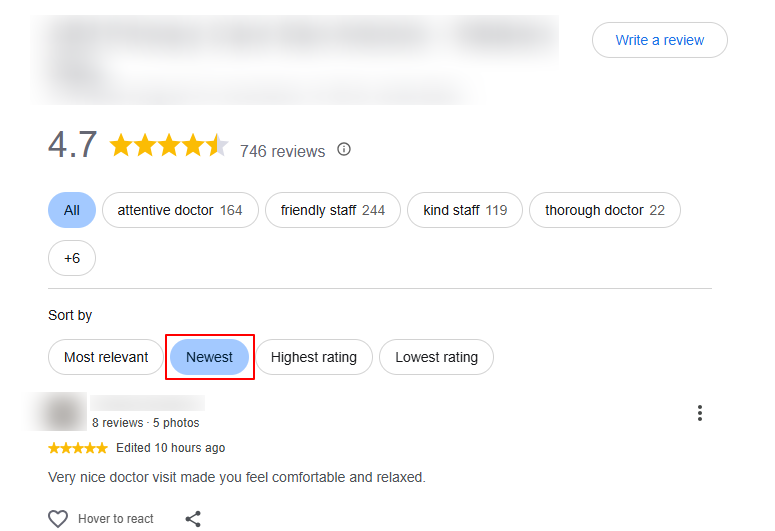
Review the latest 30 reviews and group complaints into themes such as scheduling, wait times, front-desk interactions, clinical communication, and billing.
Compare those themes with 30 reviews from approximately one year earlier.
Identify what changed before negative feedback increased.
Consider new providers, additional locations, employee departures, revised appointment schedules, new phone systems, and changes to the billing process.
For example, if complaints about unanswered calls increased after a receptionist left, review call abandonment and staffing coverage during that period.
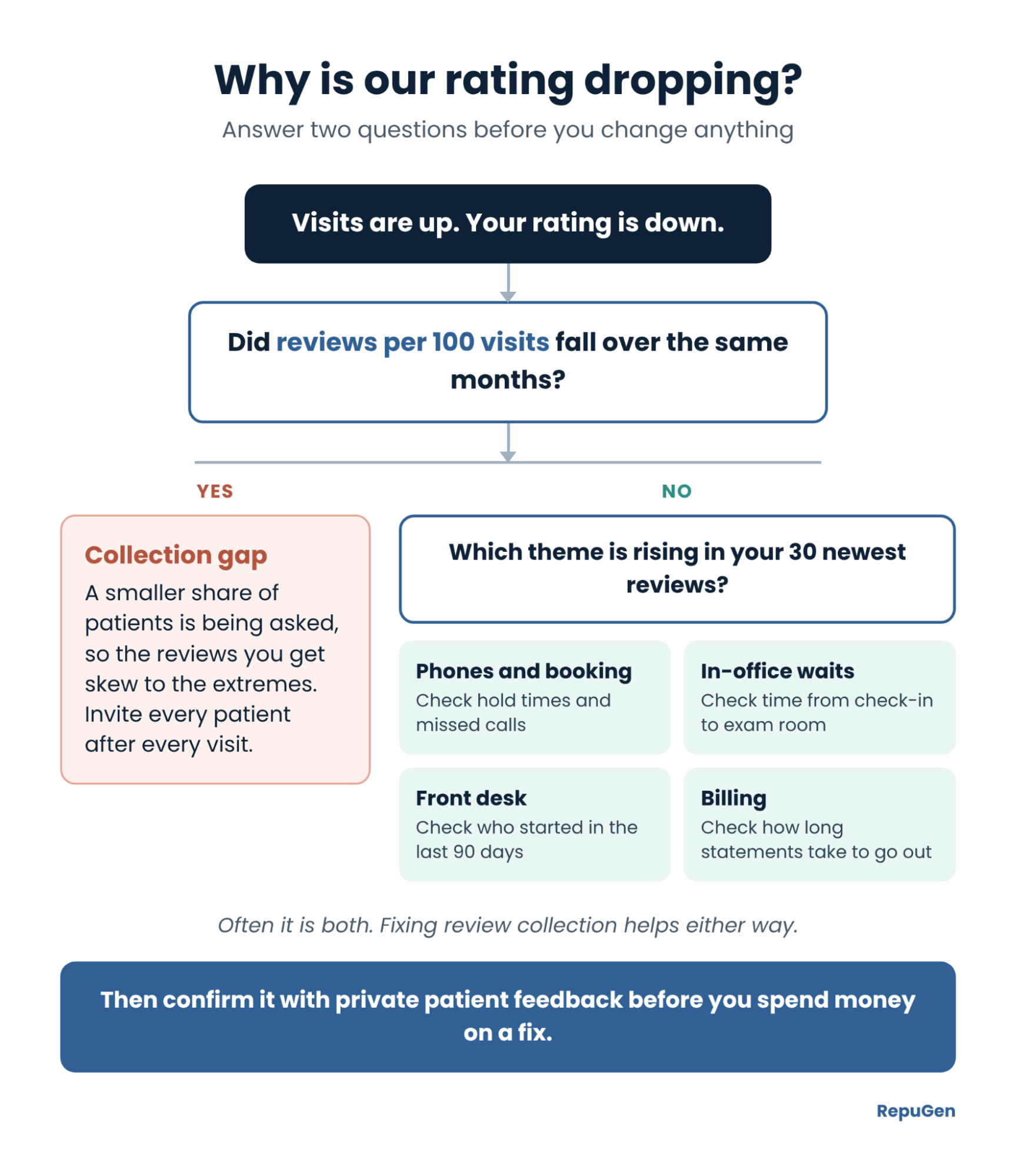
Use patient satisfaction surveys and other private feedback to confirm that the same concerns appear outside public reviews.
RepuGen's Two Mirror Test provides a framework for comparing private feedback with online reviews.
If both show the same recurring problems, investigate the underlying patient experience. If private feedback is strong but public reviews are weak, assess review coverage and whether your surveys miss patients who struggled to access care.
You don't necessarily need to reduce appointments or stop accepting new patients to improve your online reputation.
Instead, identify the operational problem that appears most frequently in feedback and address it systematically.
For example, if patients consistently mention long waits, review scheduling templates, check-in procedures, and rooming capacity before adding more appointments.
At the same time, strengthen your review collection process.
Automated patient feedback systems can help maintain consistent outreach as patient volume increases, without relying on busy front-desk employees to remember individual requests.
An important rule: Never ask only satisfied patients for reviews.
Google's review policies prohibit selectively soliciting positive reviews. The Federal Trade Commission also warns against asking only customers expected to leave positive feedback because it can create a misleading impression.
Invite all eligible patients to share honest experiences without pressure or incentives.
Finally, respond professionally to reviews about the problems you have addressed. Acknowledge concerns without disclosing protected patient information or confirming an individual's patient status.
For practices expanding across multiple providers or locations, establishing consistent processes becomes even more important. Read our guide on managing your reputation while your practice scales.
As your practice grows, manually reviewing every comment and tracking patient satisfaction across locations becomes increasingly difficult.
RepuGen's CommentWiz uses AI sentiment analysis for healthcare to identify recurring themes, track changes in patient feedback, and highlight factors affecting patient satisfaction.
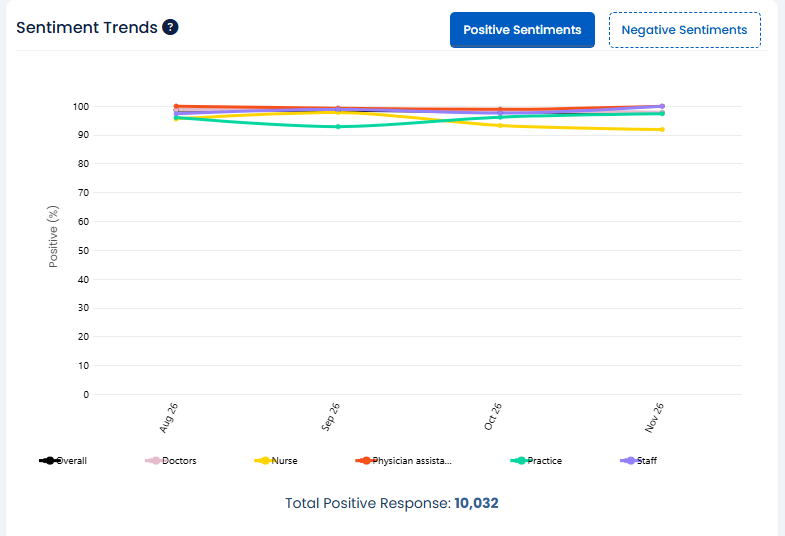
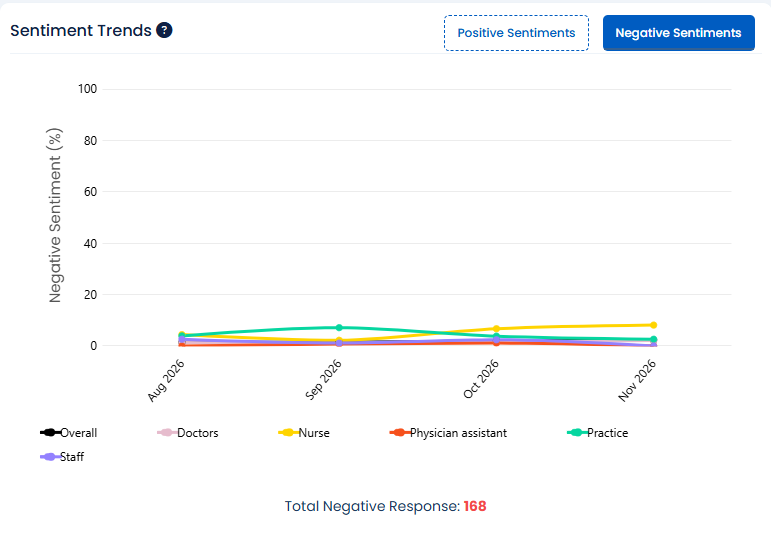
Instead of discovering a problem after several negative reviews, you can monitor emerging concerns about scheduling, communication, staff interactions, and other aspects of care.
RepuGen also supports automated patient review invitations through email and text messaging. By configuring outreach for all eligible patients, regardless of their experience, practices can keep review invitations consistent as patient volume increases.
Together, these capabilities support a more proactive approach to healthcare reputation management.
Want to understand what's affecting your practice's online reputation?
Schedule a Live Demo of RepuGen to see how patient feedback tracking, automated review invitations, and sentiment analysis can support sustainable growth.
It is relatively common, but not inevitable. A declining rating may indicate operational problems, inconsistent review collection, or both. Reviewing patient feedback alongside practice performance data can help identify the likely cause.
Calculate new reviews per 100 patient visits every month. If this number declines while patient visits increase, investigate whether your review invitation process is consistently reaching all eligible patients.
No. Google prohibits selectively soliciting positive reviews, and the FTC warns against this practice. Request honest reviews from all eligible patients without offering incentives or attempting to influence their ratings.
There is no guaranteed timeframe. Recovery depends on existing review volume, new ratings, and actual improvements in patient experience. Address recurring problems and monitor your newest reviews for signs of progress.
Practice growth doesn't automatically mean your care quality has declined. It may simply expose operational processes that were designed for a smaller patient population.
The key is understanding what changed before deciding how to respond.
Track reviews against patient volume, identify recurring complaints, and verify those patterns with operational data and private feedback.
Find the problem, fix the bottleneck, and give every patient an equal opportunity to share their experience.

Banner Image Source: ChatGPT
Recent Posts
0 Comment
Your email address will not be published. Required fields are marked *