

POSTED ON: Jun 08, 2026

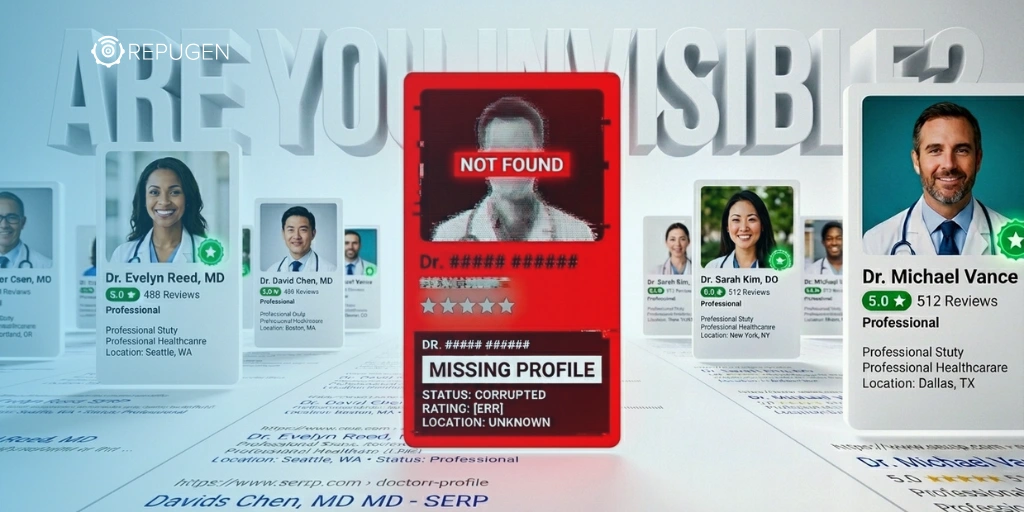
A patient asks ChatGPT for the best dermatologist in town. Another searches Google for a specialist accepting new patients nearby. Your practice has a website, strong clinical care, and a few solid reviews, yet your name never appears.
That disconnect is becoming more common.
Most practice owners assume they have an online presence because they rank occasionally on Google or maintain a basic Google Business Profile. AI search works differently. Platforms like Google AI, ChatGPT, Perplexity, and Bing Copilot evaluate practices using a much broader set of trust and visibility signals, and most healthcare organizations are missing several of them without realizing it.
Understanding how AI tools evaluate healthcare providers is quickly becoming part of staying visible online.
This audit gives you 10 specific signals to check today, in plain language, so you know exactly where your practice stands.
Each point in this audit is a simple yes-or-no check. Every “no” represents a visibility gap. The more gaps you uncover, the harder it becomes for AI systems and the patients already relying on them to confidently recommend your practice. Work through each point and keep count. Your final score will tell you how urgently you need to act.
Your Google Business Profile is still the foundation of local visibility. It is one of the primary sources AI systems reference when verifying healthcare practices, locations, and specialties.
An incomplete profile creates uncertainty immediately. If your business hours are outdated, services are missing, or your profile remains unverified, AI systems become less confident that the information is trustworthy and up to date.
What to check:
If any of those areas are incomplete, that is your first visibility gap.
For a deeper breakdown, see optimizing Google Business Profile for doctors.
If your practice appears as “Westside Family Medicine” on Google, “Westside Family Med LLC” on Healthgrades, and “Westside Medicine” on Yelp, AI systems do not automatically assume those are the same business.
It is similar to introducing yourself by a different name every time you enter a room. The confusion is subtle, but it weakens confidence in your identity.
This issue, commonly referred to as NAP inconsistency, quietly damages visibility because AI systems rely on exact matches across directories to confirm legitimacy.
What to check:
Every character in your practice name, address, and phone number should match exactly, including abbreviations, punctuation, and suite numbers.
Google’s own business representation guidelines reinforce the importance of consistency across listings. NAP inconsistency in healthcare directories
Most healthcare practices optimize for Google and stop there. Patients are no longer searching in one place.
A growing number now begin provider research directly inside ChatGPT, Perplexity, and Bing Copilot. Those systems pull information from different datasets, directories, and indexed sources than traditional Google search.
Ranking well on Google does not guarantee your practice exists in AI-generated recommendations elsewhere.
What to check:
Search your specialty and city directly inside ChatGPT and Perplexity:
Does your practice appear?
If not, the same core issues are usually responsible:
The fix overlaps with Google optimization. The urgency of checking does not.
For more on this shift, see AI in healthcare reputation.
Patients read websites visually. AI systems do not.
AI needs information clearly labeled and structured in a format it can categorize immediately. Physician name, specialty, location, services, and credentials all need to be machine-readable.
Without that structure, AI has to infer what your practice does. When uncertainty appears, visibility drops.
What to check:
Ask your developer to run your website through Google’s Rich Results Test.
Look specifically for:
If none of those are implemented, AI is effectively reading your website blind.
The full explanation of why structured data matters is covered here: reputation signals AI uses to rank healthcare providers.
AI Overviews exist to answer questions directly.
If your website is mostly built around “About Us” pages, awards, and general marketing copy, you are likely invisible to the searches that shape patient decisions earlier in the journey.
BrightEdge research found that healthcare treatment queries now show nearly complete AI Overview coverage, while symptom and condition searches exceed 90%.
That means patients are often deciding which type of provider they need before they ever search for a doctor by name.
What to check:
If your site reads more like a brochure than a resource, that is another visibility gap.
Related reading: How Google AI Overviews work for healthcare providers
Reviews are no longer just social proof for patients. They are active trust signals for AI systems.
AI evaluates three things together:
A practice with 12 reviews from 2022 may technically have a strong rating, but it still appears inactive.
According to RepuGen’s Patient Review Survey, 73.28% of patients consider reviews when choosing a provider, while 40% view reviews older than one to two years as irrelevant.
AI systems increasingly interpret stale review profiles the same way patients do.
What to check:
For a deeper look at how AI interprets review behavior, read patient reviews, doctor trust, and responding to patient reviews.
AI evaluates physician credibility individually, not just at the practice level.
This aligns closely with Google’s E-E-A-T framework: Experience, Expertise, Authoritativeness, and Trustworthiness. Incomplete physician profiles weaken all four.
A short line inside a staff directory is no longer enough.
What to check:
Each physician should have a dedicated profile page that includes:
That information should also match what appears across Healthgrades, WebMD, and other healthcare directories.
Practices that invest in stronger physician profiles often compete far more effectively in AI search, regardless of size.
Related reading: how smaller practices can win in AI search
AI tools constantly pull healthcare data from trusted third-party sources.
If your practice is missing from major healthcare directories, or if those profiles are incomplete, AI systems lose confidence in the accuracy of your digital footprint.
What to check:
Profiles should be fully completed, not simply claimed. Your specialty, bio, and location information should match your website exactly.
For more on this relationship, see local SEO and review management.
Patients do not speak the way they type.
Voice and AI searches are increasingly conversational:
Medical Economics reported in March 2026 that approximately 25% of patients already use voice assistants to find healthcare providers.
That means one in four patients may already be searching in a format many healthcare websites are not written for.
What to check:
AI visibility is not static.
Search systems continuously evaluate freshness signals:
A practice that looked highly credible a year ago can slowly disappear from visibility simply because nothing has changed since then.
What to check:
The practices that maintain visibility are usually those that treat reputation management as an ongoing operational process, not a one-time project.
Related reading: Why healthcare providers need review management and healthcare reputation strategy
If you answered “no” to three or more of these checks, your practice likely has meaningful AI visibility gaps already affecting patient discovery. Every missing signal makes it harder for
AI systems to confidently recommend your practice over a competitor with cleaner, more complete information.
AI platforms pull information from structured, high-authority sources. If your practice has incomplete directory listings, inconsistent business information, missing schema markup, or weak physician profiles, those systems may not confidently identify or recommend you. Most visibility issues stem from missing trust signals rather than technical penalties.
No. BrightEdge research confirmed that AI Overviews were removed from local provider-intent searches by late 2025. Traditional local pack and Maps results now dominate those searches. However, AI Overviews still strongly influence informational healthcare queries early in the patient journey, affecting which providers patients consider before booking locally.
There is no universal number, but consistency matters more than volume alone. AI systems favor practices generating recent, detailed reviews over time. Fewer current, authentic reviews are often more valuable than a large collection of outdated feedback.
Schema markup is structured code that helps AI systems understand your website clearly. It labels physician names, specialties, services, locations, and FAQs in a machine-readable format. Without a schema, AI systems rely on guesswork, which weakens visibility and confidence in your practice data.
AI does not discover practices by accident. It discovers practices that have built the signals it can verify and trust. Those signals are measurable, manageable, and fixable. The audit you just completed shows exactly where your gaps are. What happens next determines whether patients find your practice or someone else’s.
Set RepuGen as My Preferred Source
Banner Image Source: Google Flow
Recent Posts
0 Comment
Your email address will not be published. Required fields are marked *