

POSTED ON: Mar 16, 2026


Patient experience has become one of the most visible indicators of healthcare quality. While clinical outcomes remain central to care delivery, patients increasingly evaluate providers based on how the entire experience feels, from scheduling an appointment to post-visit follow-up. Online reviews, survey responses, and shared patient experiences now shape public perception long before a patient walks into a clinic. In fact, many of the patterns seen in top-rated healthcare practices on Google reflect consistent patient experience and thoughtful engagement with feedback over time.
In This Article
In this environment, patient feedback plays an important role in helping healthcare organizations understand how care is perceived. Feedback reveals what patients value, where operational friction may exist, and which aspects of the experience leave the strongest impression. For many practices, however, feedback historically arrives only when patients choose to leave a review on their own. This passive approach captures only a small portion of patient sentiment.
More healthcare providers are now adopting proactive feedback strategies. By inviting patients to share their experience shortly after a visit, practices gain clearer insight into the quality of the care journey while strengthening patient engagement. Consistent feedback collection allows providers to better understand patient expectations and make thoughtful improvements over time.
Proactive feedback requests occur when healthcare providers actively invite patients to share their experiences after an appointment instead of waiting for reviews to appear organically. Rather than relying on a small number of patients who feel strongly enough to leave feedback independently, practices intentionally create an opportunity for every patient to respond.
This approach differs significantly from passive feedback collection. When practices rely only on voluntary reviews, feedback tends to reflect extreme experiences. Patients who are either very satisfied or very dissatisfied are more likely to leave comments, while the majority remain silent.
Proactive outreach changes this dynamic. Patients receive a simple request to share feedback, typically through automated SMS or email surveys sent shortly after the visit. Because the interaction has just occurred, patients can easily recall the details of their experience and provide more accurate insight.
Timely feedback requests also increase participation. When patients receive a brief and convenient invitation soon after their appointment, responding often feels like a natural continuation of the care experience.
RepuGen’s feedback system is designed to make proactive feedback collection simple for both patients and providers. After a visit, a short survey is automatically sent through text message or email, allowing patients to share their experience quickly and easily.
The survey begins with a straightforward rating question, asking patients to evaluate their experience on a scale from 0 to 10. This format allows practices to gauge overall satisfaction while also giving patients the option to provide comments about their visit.
Based on the rating submitted, the feedback process follows two different paths. Patients who rate their experience highly, typically between 8 and 10, are encouraged to share their feedback publicly on review platforms. This helps amplify positive experiences and contributes to the practice’s online reputation.
Patients who provide lower ratings are guided toward internal feedback channels. This allows the practice to review concerns privately and address issues directly with the patient before they appear as negative public reviews. In many cases, this process creates an opportunity for service recovery and helps strengthen patient relationships.
This two-track approach allows healthcare organizations to both build their digital reputation and improve patient experience at the same time.
Survey insights provide a useful perspective on how patients feel about being asked for feedback. According to RepuGen survey data, 24.84% of patients say they appreciate when providers actively request feedback or reviews after a visit.
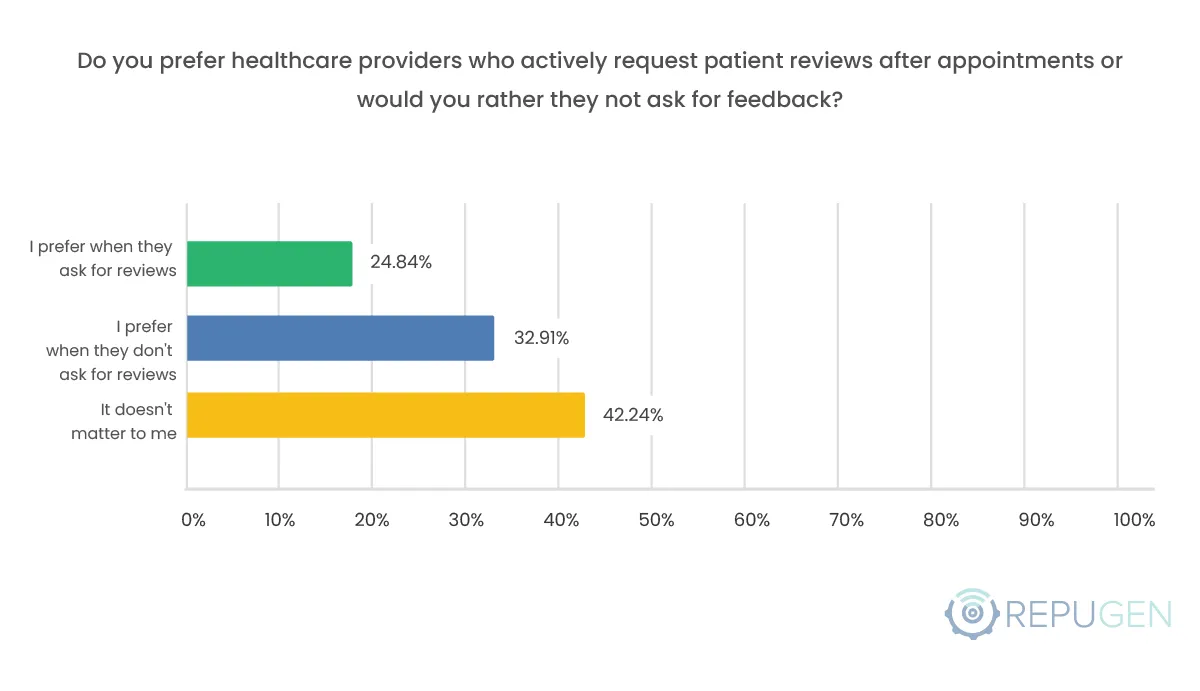
Although this figure may appear modest, it reflects an important shift in expectations. Many patients interpret a feedback request as a sign that the provider values their opinion and is open to improvement.
In addition, patient decision-making increasingly relies on shared experiences. The RepuGen Patient Review Survey shows that 73.28% of patients look for online reviews when choosing a healthcare provider, demonstrating how strongly patient feedback influences healthcare decisions today.
When feedback requests are timely and easy to complete, patients often respond positively because the request feels relevant to their recent visit.
Patients often appreciate proactive feedback opportunities for practical reasons. Their perspective is shaped by convenience, timing, and the sense that their voice contributes to improving care.
When healthcare providers invite feedback, patients often feel their opinions are valued. The simple act of asking communicates attentiveness and openness to improvement. Even when the experience has been positive, a feedback request reinforces that the practice is interested in understanding patient perspectives.
Over time, this perception can strengthen trust and contribute to a more positive patient relationship.
The timing of feedback requests significantly affects both response rates and the quality of insights collected. When surveys are sent shortly after a visit, patients can recall details of their experience more accurately, including communication, staff interactions, and overall visit flow.
Research on patient-reported experience measures also shows that feedback collected close to the care interaction provides more meaningful insights into how patients perceive and interact with healthcare services.
Sending feedback requests soon after appointments, therefore, helps practices capture clearer and more reliable patient perspectives while the experience is still fresh.
Patients also appreciate having options for how their feedback is shared. Some may prefer to leave a public review, while others may feel more comfortable sharing concerns privately.
Providing this choice helps reduce hesitation. Patients who might otherwise avoid posting negative feedback publicly can still share valuable insight with the practice.
Many patients recognize that feedback can help improve future experiences. When practices respond thoughtfully to patient concerns, patients see that their feedback can lead to meaningful improvements.
RepuGen’s internal feedback process supports this by notifying practices when lower ratings are received. Providers can reach out to understand concerns, clarify misunderstandings, or resolve issues before dissatisfaction escalates.
Proactive feedback collection not only benefits patients but also creates meaningful advantages for healthcare providers.
One of the most visible outcomes is an increase in positive online reviews. When satisfied patients receive a simple invitation to share their experience, more positive feedback becomes visible on review platforms.
A stronger online presence helps prospective patients feel more confident when evaluating providers. The RepuGen survey also shows that 31.19% of patients require at least 6–10 reviews before considering a healthcare provider, indicating that review volume plays an important role in building credibility.
Proactive feedback also allows providers to address issues earlier. Instead of discovering concerns through public reviews, practices can respond privately and resolve problems before they impact reputation.
Healthcare providers who implement proactive feedback systems often see stronger engagement when a few practical guidelines are followed.
Timing is particularly important. Requests should be sent shortly after the appointment so that the experience remains fresh in the patient’s mind.
Personalization also improves response rates. Messages that include the patient’s name or reference the visit feel more thoughtful and less automated.
Offering multiple feedback options can further encourage participation. Some patients prefer a quick survey, while others may choose to leave a review on their preferred platform.
Finally, feedback invitations should use clear and simple language. Messages that explain how patient feedback helps improve care tend to feel more meaningful and respectful.
Some healthcare providers hesitate to ask patients for feedback because they worry the request may feel intrusive or inconvenient. A common assumption is that patients prefer not to be contacted after an appointment or that feedback requests might annoy them.
Patient behavior suggests a different reality. Online reviews have become a central part of how people evaluate healthcare providers. According to the RepuGen 2025 Patient Review Survey, 73.28% of patients consider online reviews when selecting a healthcare provider, demonstrating how strongly patient feedback influences healthcare decisions today.
Another misconception is that asking for feedback primarily invites complaints. While dissatisfied patients are often motivated to share their experiences, proactive feedback requests actually broaden participation. When every patient is invited to provide feedback, practices receive a more balanced view of the overall experience rather than hearing only from extreme cases.
Survey insights also show that engagement with reviews influences patient trust. 59.48% of patients say they are more likely to choose a provider who responds to both positive and negative reviews, highlighting how thoughtful engagement contributes to credibility.
As digital healthcare research becomes more common, reviews are increasingly seen as a standard expectation. When feedback requests are timely and respectful, they reinforce transparency and demonstrate that the practice values patient perspectives.
Patient feedback offers one of the clearest windows into how healthcare experiences are perceived. From communication and scheduling to staff interactions and follow-up, patient comments reveal the moments that shape trust and satisfaction.
Proactive feedback requests allow healthcare providers to capture these insights consistently rather than relying on occasional reviews left by motivated patients.
By inviting feedback shortly after visits, practices strengthen patient engagement, identify opportunities for improvement, and build a more accurate picture of the patient experience.
Structured feedback systems such as RepuGen’s survey model make it easier to collect, understand, and act on patient input. Over time, listening carefully to patient experiences supports stronger relationships, improved care delivery, and a more trusted digital reputation.

Banner Image Source: Google Flow
Recent Posts
0 Comment
Your email address will not be published. Required fields are marked *