

POSTED ON: Aug 04, 2026

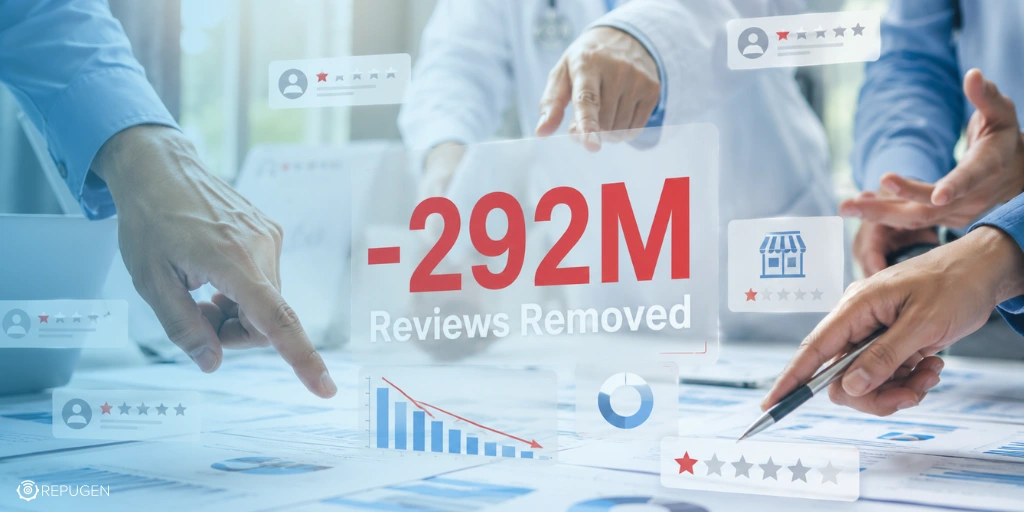
Google's review ecosystem experienced one of its largest enforcement actions to date when the company blocked or removed more than 292 million policy-violating reviews in 2025, according to its 2025 Trust & Safety Report. At the same time, Google reported removing over 13 million fake Business Profiles and blocking 79 million inaccurate Business Profile edits, while still publishing more than 1 billion legitimate reviews during the year.
For many businesses, these numbers were simply another reminder that Google's spam detection systems continue to evolve. For healthcare organizations, however, they exposed a much deeper vulnerability.
Many practices have historically relied on front desk review requests, shared office tablets, QR code campaigns, or bulk solicitation efforts to encourage patient reviews. While many of these approaches were implemented with good intentions, several also resemble the manipulation patterns Google's enforcement systems are designed to detect. As a result, even legitimate healthcare organizations found themselves losing reviews during enforcement sweeps.
Yet after reviewing more than 140 expert responses submitted through Featured.com and narrowing them to the 16 most relevant and healthcare-specific perspectives, one conclusion emerged almost unanimously. The review purge itself was not the most important story. It simply exposed how fragile an organization's reputation becomes when it depends too heavily on a single platform.
Before discussing what healthcare organizations should learn from Google's enforcement efforts, it's important to understand what actually happened.
According to Google's 2025 Trust & Safety Report, published through the Google Maps Blog on April 16, 2026, Google's automated detection systems blocked or removed more than 292 million policy-violating reviews during 2025, up from 240 million the previous year. During the same period, the company removed over 13 million fake Business Profiles, blocked 79 million fraudulent Business Profile edits, and continued publishing more than 1 billion helpful reviews that complied with its policies.
Those figures make one point clear.
Google was not removing reviews indiscriminately. Its enforcement targeted review activity that matched known manipulation signals, including incentivized reviews, abnormal review velocity, review gating, coordinated submission patterns, and other behaviors designed to influence ratings artificially. Understanding that distinction matters because it changes the lesson healthcare organizations should take away from the purge.
Caleb Johnstone, SEO Director at Paperstack, observed that the effects extended well beyond individual businesses.
"After the enforcement activity, we saw Google's share of all online reviews fall from roughly 83% to 71% as businesses and consumers diversified toward other review platforms. Healthcare practices were among the hardest hit because a significant percentage of the removed reviews were 5-star ratings that had often been generated through front desk solicitation or highly structured review campaigns. Even organizations with strong patient satisfaction suddenly found themselves rebuilding trust signals they assumed were permanent."

Johnstone's observation illustrates an important consequence of the purge. Losing reviews didn't simply reduce a provider's total review count. It also prompted patients to rely more heavily on alternative healthcare review platforms when evaluating providers.
Dr. Andrzej Kulesza, Co-Founder and Medical Director of Zeus Detox & Rehab, cautioned against assuming that only organizations violating Google's policies were affected.
"The challenge wasn't that every removed review was fraudulent. Legitimate healthcare providers were sometimes caught in broader enforcement actions because the acquisition patterns surrounding their reviews resembled manipulation. Recovery wasn't always immediate or consistent, which meant practices with completely authentic patient experiences could still lose visibility while waiting for Google's systems to reassess their profiles."

That distinction is critical.
Google's enforcement was aimed at identifying patterns, not judging the quality of patient care delivered by healthcare organizations. A highly respected practice could still lose reviews if its collection methods produced signals commonly associated with manipulation.
Understanding those patterns is far more valuable than simply knowing how many reviews disappeared.
Although the expert responses represented professionals working across healthcare marketing, reputation management, local SEO, healthcare technology, and patient acquisition, they reached a remarkably consistent conclusion.
The biggest lesson from Google's review purge wasn't that healthcare organizations should stop collecting patient reviews.
It was that they should stop treating one platform as the foundation of their reputation.
Stephen Taormino, Founder and CEO of CC&A Strategic Media, summarized the consensus succinctly.
"Healthcare organizations need to stop building their reputation on rented land. Google is an incredibly important platform because that's where many patients begin their search, but it's still someone else's ecosystem governed by someone else's policies. If your organization's credibility can disappear because one platform changes its enforcement or removes reviews, then you've built visibility rather than resilience."

Roman Sydorenko, CEO of seobro, framed the situation from a strategic perspective.
"The purge didn't create a reputation problem. It revealed one that many healthcare organizations already had. Too many practices measured reputation almost entirely by their Google star rating instead of treating patient trust as something that should exist across multiple platforms, owned channels, and ongoing patient relationships. That's concentration risk, not reputation strategy."

Elijah Fernandez, Co-Founder and CTO of CEREVITY, expressed the same idea even more directly.
"If one company can remove a significant portion of your credibility overnight, then that credibility was never entirely yours. It belonged to a platform that happened to display it. Healthcare organizations need reputation systems that patients can verify across multiple trusted sources rather than depending on one company's interface to communicate trust."

While each expert approached the issue differently, all three arrived at the same conclusion. Reputation should be viewed as an organizational asset, not a platform asset.
Nikhil Pai, Founder of Chronicle Technologies, focused on what separated organizations that recovered quickly from those that struggled.
"The providers that adapted most effectively already had direct feedback systems, patient satisfaction programs, and consistent review generation processes operating independently of Google. When reviews disappeared from one platform, patient trust didn't disappear with them because their reputation wasn't dependent on a single source of validation."

Taken together, these perspectives reveal why the review purge became such an important moment for healthcare organizations.
Google's enforcement didn't fundamentally change how patient trust works.
It exposed which organizations had built reputation strategies resilient enough to withstand platform changes and which had unknowingly concentrated too much of their credibility in a single place.
That distinction shapes every practical recommendation that follows.
Most coverage of Google's review purge stops after advising businesses to "diversify their review platforms." While that's sound advice, it doesn't answer the question healthcare organizations were left asking after the enforcement actions:
What actually caused so many reviews to be removed?
The expert responses point to a more practical answer. Google's enforcement wasn't targeting healthcare organizations or positive reviews. It was targeting review acquisition patterns that resembled manipulation, regardless of whether the underlying patient experiences were genuine.
Christopher Coussons, Director at Visionary Marketing, saw a clear difference between organizations that followed Google's guidelines consistently and those that relied on more aggressive review generation tactics.
"Across the accounts we reviewed after the enforcement actions, practices that had previously relied on incentivized review campaigns consistently lost substantially more reviews than organizations that collected feedback organically. The difference wasn't marginal. In many cases, businesses with a history of incentive-based collection lost roughly four times as many reviews during enforcement sweeps. The purge wasn't random. It reflected patterns Google's systems had likely been monitoring for some time."

One of the most common patterns involves a workflow that has long been popular in healthcare practices.
Chris Burdick, Senior SEO and AI Search Consultant, pointed to the use of shared tablets or kiosks at the front desk, where patients are encouraged to leave Google reviews before leaving the office.
"From Google's perspective, dozens of reviews submitted from the same device or the same IP address over a short period look remarkably similar to coordinated review manipulation. Many healthcare organizations adopted front desk tablets simply because they made the review process easier for patients. Unfortunately, those same convenience measures produce exactly the technical signals Google's fraud detection systems are designed to identify."

Dr. Andrzej Kulesza identified three additional patterns that deserve attention because they often appear legitimate from an operational standpoint but can still resemble manipulation when viewed algorithmically.
"Practices should be especially cautious about aggressive review solicitation campaigns, review gating software that encourages only satisfied patients to post publicly, and QR code campaigns that generate unusually concentrated review activity from the same location. None of these approaches automatically violate policy in every situation, but together they create behavioral patterns that Google's enforcement systems increasingly associate with manufactured reviews."
Viewed individually, each of these practices may seem relatively minor.
Viewed together, they reveal an important shift in how healthcare organizations should think about review collection.
The goal is no longer to maximize review volume through the fastest possible process. It's to establish a steady, authentic, and policy-compliant review workflow that reflects normal patient behavior. Consistent requests sent after appointments, without filtering patients or encouraging submissions from shared devices, create the kind of review profile that both patients and platforms are more likely to trust.
For restaurants, retailers, or hotels, responding to a questionable review is usually straightforward.
Healthcare providers operate under very different rules.
Even when a review appears misleading or unfair, providers cannot publicly confirm that someone was a patient or disclose details that could reveal protected health information. That limitation makes healthcare reputation management fundamentally different from reputation management in most other industries.
John Russo, Vice President of Healthcare Technology Solutions at OSP Labs, explained why this distinction becomes especially important after events like Google's review purge.
"Unlike most businesses, healthcare providers can't simply respond point by point to challenge an inaccurate review. Even acknowledging that someone received care can create a HIPAA concern. A poorly written response can expose the organization to greater risk than the review itself, which means every response needs to be guided by a privacy-first process rather than an emotional reaction."

Elijah Fernandez believes those privacy obligations create an additional challenge when organizations lose reviews or experience sudden rating changes.
"Healthcare organizations have fewer options for publicly defending themselves because patient privacy always comes first. Other industries can explain the circumstances surrounding a review or dispute inaccuracies in detail. Providers generally can't. That makes proactive reputation management much more important than reactive reputation management."
Adam R. Collins, Founder of Adam Collins, emphasized that this responsibility extends beyond physicians.
"Every healthcare organization should establish a documented review response process before a problem occurs. Staff needs clear guidance on who responds, how responses are reviewed, and how HIPAA requirements are protected. Trying to develop those procedures after a reputation issue emerges almost always leads to inconsistent decisions."

This is why healthcare organizations need more than a review response policy.
They need a HIPAA-aware review response process that balances professionalism, patient privacy, and regulatory compliance. RepuGen's guide on How to Respond to Negative Patient Reviews explores these principles in greater detail. It demonstrates how compliant response workflows can help practices engage with patient feedback while protecting confidential information.
The experts agreed that healthcare organizations shouldn't stop asking patients for reviews. Instead, they should build review collection and monitoring processes that remain effective even as platforms continue strengthening their enforcement systems.
Several recommendations appeared repeatedly throughout the responses.
Collect reviews consistently rather than in bursts. Josiah Roche, Fractional CMO at JRR Marketing, noted that practices earning a steady stream of 6 to 10 new reviews each month often appear more credible than organizations with hundreds of older reviews but little recent activity. Consistency benefits both patients evaluating current experiences and platforms looking for authentic review patterns.
Document your review process. Kruno Sulić, Founder of Cliprise, recommended keeping clear records of how review requests are delivered, which systems or vendors are involved, and what procedures should be followed if reviews are removed. Documentation allows organizations to investigate enforcement actions based on evidence rather than assumptions.
Verify operational performance after significant review losses. Dr. Christopher Croner, Principal at SalesDrive, LLC, advised organizations to compare online review trends with patient satisfaction surveys and other experience metrics within 72 hours whenever a platform removes 5% or more of accumulated reviews. This helps leadership distinguish between a platform enforcement action and a genuine decline in patient experience.
The common thread across these recommendations is consistency.
Healthcare organizations should avoid treating reputation management as a series of isolated campaigns. Instead, review collection, monitoring, and response should become continuous operational processes. RepuGen's guides on How to Ask Patients for Reviews and its Healthcare Patient Review Behavioral Study provide additional best practices for building compliant, patient-centered review programs.
Google's review purge didn't penalize healthcare organizations simply for collecting patient reviews.
It targeted review acquisition patterns that appeared manufactured, including aggressive solicitation campaigns, shared device submissions, review gating, and other behaviors that reduce confidence in review authenticity.
The lesson isn't to collect fewer reviews. It's to collect them more consistently, more transparently, and across a broader reputation ecosystem. Healthcare organizations should also monitor more than one review platform and establish a HIPAA-compliant response process before they need it.
Taken together, these recommendations point toward a closed-loop reputation management system. Steady, authentic review collection, multi-platform monitoring, sentiment analysis, and compliant review responses help organizations build a reputation that isn't dependent on a single platform or vulnerable to sudden policy changes.
If you'd like to strengthen your organization's reputation strategy with a compliant, multi-platform approach, contact the RepuGen team to learn how its reputation management solutions help healthcare organizations collect authentic patient feedback, monitor reviews across platforms, and respond confidently while protecting patient privacy.
Banner Image Source: Google Flow
Recent Posts
0 Comment
Your email address will not be published. Required fields are marked *